
Understanding Sciatica: The Role of Chiropractic Care and Mechanical Traction
Sciatica Relief & Mechanical Traction | Well Adjusted
2/16/20264 min read


Sciatica & Mechanical Traction in Brooklyn: Non-Surgical Relief for Disc & Nerve Pain
If you are experiencing a sharp, burning pain shooting down your lower back, through your glutes, and into your leg, you are likely dealing with sciatica. Sciatica isn't a standalone medical diagnosis—it is a distinct symptom telling you that the largest nerve in your body is compressed, irritated, or inflamed.
At Well Adjusted, we specialize in non-invasive, drug-free solutions to resolve nerve compression at its root source. By combining targeted chiropractic adjustments with specialized mechanical traction therapy, we help patients across Brooklyn overcome debilitating leg pain and regain full mobility without invasive surgery or prescription pain medications.
What Is Sciatica? Understanding the Root Cause
The sciatic nerve originates in the lumbar spine (lower back) and branches down through the hips, buttocks, and down the back of each leg into the feet. When this nerve becomes pinched, it triggers symptoms that range from a dull, persistent ache to severe, shock-like electrical sensations.
Common Causes of Sciatic Nerve Compression:
Herniated or Bulging Discs: When the inner gel-like core of a spinal disc pushes outward through a tear in the outer ring, it presses directly against the adjacent spinal nerve roots.
Degenerative Disc Disease (DDD): As spinal discs wear down with age or repetitive micro-trauma, they lose water content and collapse in height, narrowing the space where nerve roots exit the spine.
Spinal Stenosis: A structural narrowing of the spinal canal or intervertebral foramina that crowds and pinches nerve pathways.
Piriformis Syndrome: Tightness or spasms in the piriformis muscle (located deep within the buttocks) that trap the sciatic nerve.
Key Symptoms to Watch For:
Radiating pain down one side of the lower back, buttock, or leg.
Numbness, tingling ("pins and needles"), or burning sensations in the calf or foot.
Muscle weakness in the affected leg or difficulty lifting the foot (foot drop).
Pain that worsens after prolonged sitting, standing, or coughing.
How Chiropractic Care Directly Addresses Sciatica
Conventional approaches often rely on muscle relaxers, anti-inflammatory drugs, or epidural steroid injections. While these may temporarily mask pain signals, they do not resolve the mechanical pressure pressing against the nerve.
Chiropractic care focuses on restoring normal biomechanics to the spine. By correcting vertebral misalignments (subluxations), targeted chiropractic care helps:
Reduce Joint Pressure: Realigning structural dysfunctions removes localized mechanical stress from the affected nerve root.
Decrease Inflammation: Normalizing joint motion stimulates lymphatic drainage and reduces chemical irritation surrounding the nerve bundle.
Restore Mobility & Function: Gentle spinal manipulations improve overall range of motion, relaxing protective muscle guarding in the lower back and pelvis.
The Benefits of Mechanical Traction for Sciatica & Disc Health
While standard manual adjustments are vital for spinal alignment, condition-specific tools are often required when sciatica is driven by disc herniations or severe disc degeneration. Mechanical traction (a specialized form of non-surgical spinal decompression) is one of the most effective non-invasive modalities for disc-related nerve compression.
How Mechanical Traction Works: The Decompression Effect
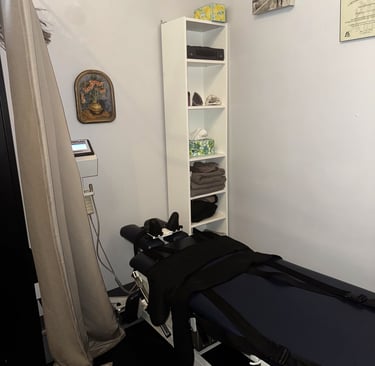
During a mechanical traction session, you lie comfortably on a specialized motorized table fitted with soft harness restraints. The table applies controlled, computerized cycles of gentle distraction (pulling) and relaxation to the lumbar spine.
This cyclic traction creates two major physiological benefits:
Creates Negative Intradiscal Pressure: By gently lengthening the spine and widening the space between adjacent vertebrae (the intervertebral foramen), traction creates a vacuum effect inside the disc space. This negative pressure helps draw protruding or herniated disc material back inside the disc borders, pulling it away from the pinched sciatic nerve root.
Promotes Nutrient Exchange & Rehydration: Spinal discs have very limited direct blood supply in adulthood. The rhythmic "pump" of traction forces oxygen, fluid, and essential nutrients directly into damaged, dehydrated disc tissues, accelerating the body's natural cellular repair mechanism.
Why Choose Well Adjusted for Sciatica Relief in Brooklyn?
Every patient’s spine is unique. At Well Adjusted, located conveniently in Brooklyn (serving Crown Heights, Prospect Heights, Bed-Stuy, and surrounding neighborhoods), we don't believe in one-size-fits-all treatments.
We perform a thorough clinical evaluation, orthopedic examination, and neurological testing to pinpoint the exact level of your nerve irritation. Based on your diagnostic findings, we design a customized, multi-modal treatment plan that may incorporate:
Targeted Chiropractic Adjustments to optimize pelvic and spinal alignment.
Computerized Mechanical Traction to decompress herniated or degenerated discs.
Myofascial Soft-Tissue Therapy to release stubborn muscle spasms in the lower back and gluteal region.
Core Stabilization & Rehabilitation Exercises to strengthen the supporting musculature and prevent future flare-ups.

Frequently Asked Questions About Sciatica & Traction
Does mechanical traction hurt?
No. Mechanical traction is gentle, rhythmic, and relaxing. Most patients feel a gentle, relieving stretch in their lower back during treatment, and many even fall asleep on the table. The settings are customized to your body weight and comfort level.
How many sessions will I need?
Because disc tissue requires time to heal and rehydrate, relief is typically progressive. While many patients notice reduced leg pain within the first few visits, a complete care plan usually involves a series of regular sessions over a few weeks to achieve lasting structural stability.
Do I need a primary care physician referral to see a chiropractor?
No. In New York State, you do not need a referral from a primary care physician to consult with a Doctor of Chiropractic. You can schedule an evaluation directly with our office.
Living with shooting leg pain, weakness, or numbness can make simple daily activities—like walking, working, or sitting comfortably—feel impossible. You don't have to rely on daily painkillers or wait for surgery to find relief.
Contact Well Adjusted today to schedule your comprehensive sciatica evaluation and discover how chiropractic care and mechanical traction can help you move without pain again.
Call: (718) 855-3100
© 2026. All rights reserved.
Text: (833) 375-0049
Office Hours
Monday/Tuesday/Thursday: 11 am-7 pm (Break 3-4)
Wednesday: 1 pm-7 pm
Friday: 11 am-3 pm
Saturday: 10 am-3 pm






1000 Dean St.
Ste 216
Brooklyn NY 11238

Fax: (718) 878-4347


Well Adjusted Chiropractic in Brooklyn provides gentle, effective care for neck pain, back pain, sciatica, prenatal patients, no-fault auto accident injuries, workers’ compensation cases, and sports injuries. Our chiropractors proudly serve patients throughout Brooklyn, including Crown Heights, Clinton Hill, and Prospect Heights.